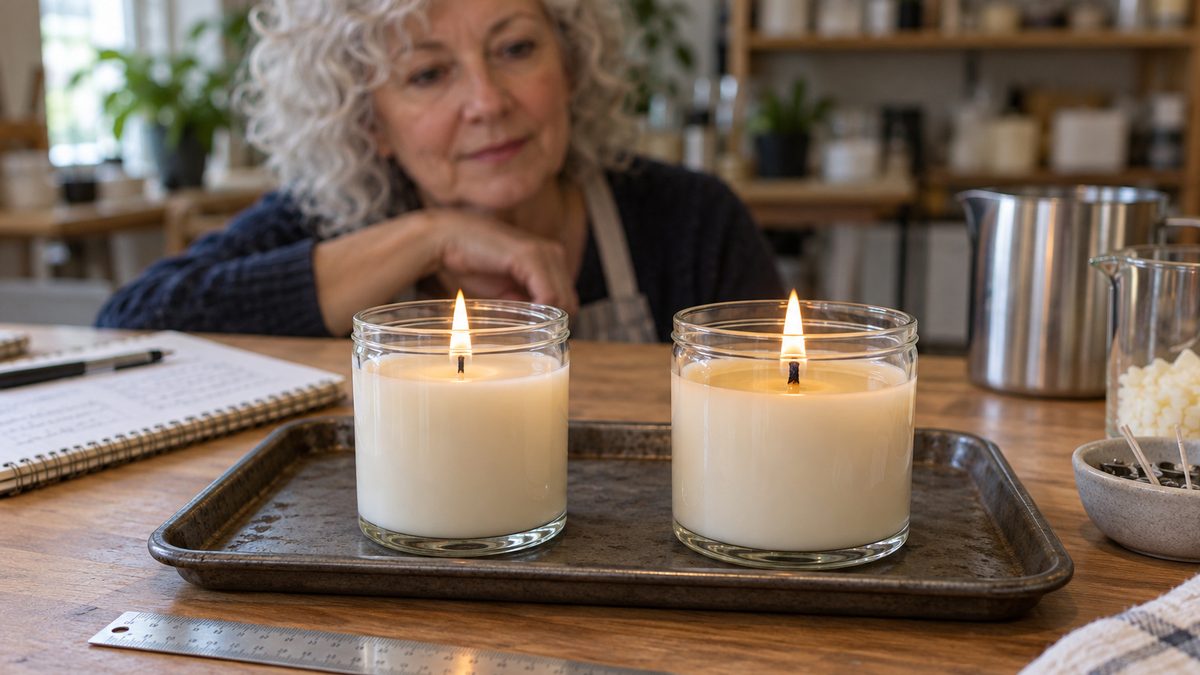
Neither wick is better in general. A wooden wick gives a wide, flat flame and a soft crackle, and it is made for container candles only. A cotton wick gives a taller, rounder flame, comes in far more sizes, and works in containers, pillars and votives. What really changes when you switch is the testing: wooden wicks come in fewer steps, are sized by two measurements instead of one, are fussier about wax and fragrance load, and are trimmed shorter. If you size a wooden wick the way you size a cotton one, it is easy to end up with a flame that drowns after a minute.
This guide answers the questions makers ask most when they think about switching, using what Lone Star Candle Supply and Makesy publish about wooden wicks and the CandleScience chart behind our wick test planner. At the end there is a worked test plan for one jar in soy wax, with the wax and oil worked out, so you can see what a fair side-by-side test actually costs.
How is a wooden wick built, and why does that matter?
A cotton wick is braided fiber, and in the common series (CD, ECO, LX) it is a flat braid built to curl at the tip as it burns, so it trims itself as it goes. Lone Star’s wicking guide describes wooden wicks as two thin, identical pieces of wood pressed together. The flame sits along the top edge of that strip, which is why it burns wide and low rather than tall, and why you hear the crackle.
Shape is the reason the sizing rules change. A round cotton wick has one size number. A wooden wick has a width (how wide the strip is) and a thickness (how much wood there is). Makesy’s guide to selecting a wooden wick puts it simply: the width mostly sets how wide the melt pool gets, and the thickness mostly sets the overall burn and flame size. So a wooden wick can be wrong in two different directions, and the fix depends on which one.
Can I use a wooden wick in any candle?
No. Lone Star says wooden wicks suit containers only, never pillars or votives, because a pillar has no glass to hold the wide melt pool. Wax matters too. Lone Star says wooden wicks pair most easily with paraffin and paraffin blends, that pure soy needs one of the larger sizes, and that beeswax and palm wax don’t burn hot enough to keep the flame open. Makesy makes the same point from the other side: oilier, denser waxes need more wood, and it says a 100% soy wax will almost always need its thickest (.04) wicks to burn well.
Cotton is far less picky. Its series were each built with certain waxes in mind (Lone Star describes ECO for soy and other natural waxes, LX for paraffin and blends, CD for harder, thicker waxes), but between them there is a cotton wick for nearly every wax and candle type. If you make pillars, votives or beeswax candles, cotton is the answer, and the comparison ends here.
How do I pick a starting size for a wooden wick?
The same way as cotton, by the inside diameter of the jar at its widest point, but on a much coarser scale. The CandleScience chart in our wick size chart splits jars from 1.75 to 4.2 inches into six diameter ranges, and each cotton series has ten or more sizes. Lone Star sells wooden wicks in four sizes and gives a maximum jar width for each, separately for soy and paraffin.
| Wooden wick (Lone Star) | Max jar width in soy | Max jar width in paraffin | Cotton for a 3.03 in jar in GB 464 soy (CandleScience chart) |
|---|---|---|---|
| Small | Not recommended | 2.25 in | — |
| Medium | 2.25 in | 3.0 in | — |
| Large | 3.25 in | 3.25 in | CD 18 or ECO 14 |
| X-Large | 3.5 in | 3.75 in | — |
Two things stand out. First, a single wooden size covers a whole inch of jar widths in soy (Medium tops out at 2.25 in, Large at 3.25 in), where cotton steps through several sizes in the same span. That makes a wooden wick more likely to be slightly too big or slightly too small for any given jar, and it is why Lone Star says to test before you scale up. Second, these are one supplier’s numbers for its own wicks, tested in a single-pour soy and a single-pour paraffin container wax. Wooden wicks from another shop are cut to different widths and thicknesses, and Makesy sizes its own by width (.375, .5, .625 inch and up) and by thickness (.01 to .04). Use the chart from the shop you buy from, not this one.
Do I still test three sizes side by side?
The idea is the same: pour identical candles that differ only in the wick, burn them together, and compare. Our planner builds a cotton test from the chart size plus one size down and one size up. With wooden wicks, that “one size either side” may not exist in a useful form, because the next size down can be far too small. In soy, a 3.03 inch jar is well past Medium’s 2.25 inch limit, so the sensible test is Large against X-Large rather than three sizes.
Makesy’s guide gives the clearest rules for moving between wooden sizes once you have burned a test. If the candle runs hot (a full pool well before two to three hours, a large dancing flame, smoke or darkened wax), go down one thickness, and if you are already at the thinnest, go down one width. If the flame drowns, stays small or goes out, go up one thickness at the same width. If the flame is good but the pool never reaches the edge, keep the thickness and go up one width. What Makesy looks for in a good burn is a full melt pool in two to three hours, about half an inch deep, with a flame around half an inch tall. Lone Star’s general target for any wick is a pool that reaches the glass within two to four hours.
Cotton testing reads the same signs, but you only have one dial to turn: bigger or smaller in the same series, or a switch to a different series. The candle troubleshooter lists tunneling, soot and mushrooming with their usual causes for cotton wicks, and most of the reasoning carries over.
Why won’t my wooden wick stay lit?
This is the most searched wooden wick problem, and the usual causes are worth checking in order. The first is length. Makesy says wooden wicks should be trimmed to about 1/8 to 3/16 inch, against the familiar 1/4 inch for cotton, and that a wick left too long can make the flame dim or go out. A wooden wick left at cotton length is the most common reason the flame struggles at the start.
The second is ash. Makesy notes that wooden wicks build a little ash at the tip as they burn, and that heavy ash makes the flame smaller. It can be broken off once the candle is cool, before relighting. The third is too little wood for the wax. If the trim is right and the flame still drowns, Makesy’s rule is one thickness up, and Lone Star’s soy column already pushes you toward the larger sizes. The fourth is fragrance. Lone Star advises holding back on fragrance oil with wooden wicks, because too much oil dampens the crackle, and an oil-heavy pool is harder for a strip of wood to draw from.
Cotton wicks have their own version of this, usually a wick too small for the jar or a heavy oil that clogs the braid, but they rarely go out from trimming alone.
Do wooden wicks need a lower fragrance load?
Lone Star doesn’t give a number, only the advice to hold back, and Makesy says dyes, micas and fragrance concentration all change how a wick burns, so you should test candles exactly as you plan to sell them. The practical takeaway is that a wooden wick test should use your real fragrance at your real load, and that if a test drowns, trying the same wick at a slightly lower load is a fair second experiment alongside one thickness up. Change one of those at a time, not both, or you won’t know which one helped. Our guide on comparing two wick tests covers how to keep the comparison fair.
For cotton, the CandleScience chart was tested with no dye at a 7.5% fragrance load, and CandleScience says moderate to heavy dye and heavy oils often need one size up. Either way, the wax’s own published maximum on our wax specs page is a ceiling, not a target.
Worked example: testing both wicks in a 3 inch soy tumbler
Say you want to decide between cotton and wood for CandleScience’s tumbler jar, which CandleScience lists at 3.03 inches across the inside and 8.5 oz of wax to the fill line, in Golden Brands 464 soy at an 8% fragrance load (of the wax).
Each candle first. In the candle wax calculator, choose the tumbler jar under “Pick a common jar,” set the load to 8% of the wax, and it splits the 8.5 oz into about 7.87 oz of wax and 0.63 oz of fragrance oil.
Then the test. The wick test planner puts a 3.03 inch jar in the chart’s 2.95 to 3.29 inch range, where CandleScience suggests CD 18 or ECO 14 for GB 464. Choosing the ECO series, it plans ECO 12, ECO 14 and ECO 16. For the wooden side, Lone Star’s soy column points to Large (up to 3.25 in), with X-Large as the one worth testing beside it. That is five candles at one per wick, or ten at two per wick, which the planner uses as its default so one odd candle doesn’t decide the result.
For ten candles the planner’s numbers add up to 85 oz of finished candle: about 78.7 oz of wax (just under 5 lb) and 6.3 oz of fragrance oil. Pour them all from one batch so the wax and oil are identical, and set the wooden wicks to the trim length their supplier gives before the first light. Then cure for the time your wax maker recommends before any burn, and burn all ten together in four-hour sessions, writing down when each pool reaches the glass, how tall the flame is, and any soot or drowning.
If the wooden wicks drown and the cotton ones burn well, that doesn't settle cotton vs wood yet. Before giving up on wood, Makesy's next step is the same width one thickness up, or a test at a lower fragrance load. A fair verdict needs the wooden wick at its best size, not its first one.
If you ever switch to IGI 6006, the paraffin-soy blend, the same jar is a good example of a size boundary: 3.03 inches is just past the 3.0 inch limit Lone Star gives for a Medium wooden wick in paraffin, so Large is the chart pick, and a jar that close to a limit is where testing the size below earns its keep.
So which should I choose?
Choose by the candle you want to sell and the time you are willing to spend testing. Wooden wicks give a look and sound that some buyers want, they suit container candles in paraffin and blends most easily, and they need larger sizes, careful trimming and a lighter hand with fragrance in soy. Cotton wicks cover every candle type and wax, come in fine size steps, and are the simpler place to start if you are new or make several jar sizes. Many shops sell both and test each in its own jars, which is fine as long as each wick is tested in the candle it will go out in.
Honest limits
Everything above comes from what Lone Star Candle Supply, Makesy and CandleScience publish, and each of them says its charts are starting points that change with wax, fragrance, dye and jar. Wooden wick sizes are not standard between brands, so a “Large” or a “.03” from one shop is not the same wick from another. Nothing here means a wick is safe in your candle. Only a full burn test of the finished candle, down to the last quarter inch of wax, can tell you that, and safety warnings belong on every candle label whichever wick you use.
Sources
- Lone Star Candle Supply: guide to wicking (wooden wick sizes and maximum jar widths for soy and paraffin, containers only, waxes, fragrance, melt pool target)
- Makesy: a guide to selecting your wooden wick (width vs thickness, burn test markers, which way to size)
- Makesy: wooden wick vs cotton wick (trim lengths, ash, carbon buildup)
- CandleScience wick guide (cotton starting wicks by wax and jar diameter; tumbler jar dimensions from CandleScience’s container page)