Two things decide most of a wick choice: the wax and the width of the jar. This chart gives a starting wick for each popular container wax at each jar width, so you know which three sizes to buy for your first burn test.
Where these sizes come from
Every container size below is from the CandleScience wick guide, read on October 27, 2026. CandleScience tested with no dye and 7.5% fragrance oil (1.2 oz per pound) and calls its picks estimates and a starting point for your own tests. Two waxes from our specs table, C-3 and beeswax, are left out because the guide gives no sizes for them.
Container wicks by wax and jar diameter
Find your wax on the left and your jar’s inside diameter across the top. The first size in each cell is CandleScience’s pick and the second is its runner-up; “2×” means two wicks in one jar.
Sizes from the CandleScience wick guide, read October 27, 2026. Your supplier’s own chart comes first if it differs.
The fastest way to use the chart is through our wick test planner. Enter your wax and jar width, and it picks the starting wick from this table, adds one size down and one size up to test beside it, and prints a burn log for the three jars.
How to measure your jar
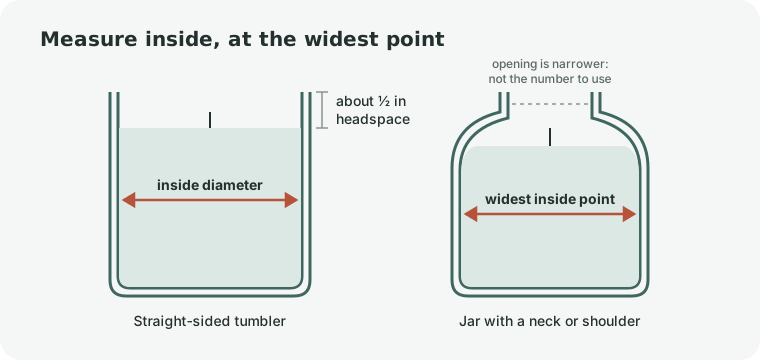
The number the chart wants is the inside diameter at the jar’s widest point, because that is how far the melt pool has to travel. Measuring the outside adds the thickness of the glass on both sides, which can push a heavy jar into the next row up. Measuring across the opening has the opposite problem on jars with a neck or a rounded shoulder, where the mouth is narrower than the body. A ruler laid across the inside of a straight-sided tumbler is enough; for a shaped jar, a pair of calipers or a flexible tape around the outside, minus the glass, gets you closer.
The melt pool has to reach the widest part of the jar, so that is the width to look up.
If your jar falls between two rows, test the smaller size first. CandleScience’s reasoning is practical: a wick that is slightly small leaves a little wax on the walls in early burns, while one that is too large can mean a tall flame, soot, a jar that gets dangerously hot and a candle that burns down too fast.
Reading wick names
Wick names are a series and a number, and the number only means something inside its own series. CandleScience puts it simply: an ECO 14 is always bigger than an ECO 10, but numbers between series are not comparable, so an LX 22 may or may not be bigger than an ECO 8. That is why the chart names a whole size rather than a “wick size 10”, and why switching series means starting the test over.
The series themselves are built differently, which is what makes each one suit some waxes better than others. Lone Star Candle Supply describes them this way in its wicking guide. CD wicks are flat-braided cotton woven with a paper filament and handle harder, thicker waxes well. ECO wicks are flat, coreless cotton braided with thin paper threads so the tip curls and trims itself, and they are built for soy and other natural waxes. LX wicks are flat-braided cotton treated to curl, which cuts mushrooming and soot, and work well in paraffin and blends such as IGI 6006. HTP wicks bend their tip into the hottest part of the flame. Zinc-core wicks have a thin wire center that keeps them standing in votives and pillars, and Lone Star does not recommend them in soy. Wooden wicks give a wide, flat flame and a crackle and are meant for containers only.
Why two suppliers’ charts disagree
If you check a second chart, expect different answers. CandleScience tests each wax separately, so its chart has a row per wax. Lone Star rates most of its series in a base paraffin and says soy and single-pour paraffin often need one to three sizes larger, while its ECO chart is rated in soy. For a jar 3.1 inches across, Lone Star’s ECO chart gives ECO 10, while CandleScience’s runner-up for GB 464 at that width is ECO 14, two sizes apart in the same series. Both are honest starting points tested in different conditions, which is exactly why every chart ends with “test it.” Use the chart from the shop you buy the wick from, and let your burn test settle it.
What moves the right wick up or down
The chart assumes an undyed candle with 7.5% fragrance, so anything that changes how easily fuel reaches the flame can change the answer. Fragrance is the biggest one. CandleScience explains that the wick draws melted wax and oil up by capillary action, and heavy or thick oils, such as many vanillas, spices and woody blends, are harder to pull up, so the flame runs weak. Light citrus and floral oils flow easily and can make the same wick burn hot. Dye pushes in one direction: the particles in liquid dyes and dye blocks can clog the tiny channels in a braided wick, so CandleScience says a moderate to heavy color often needs one size up.
Your fragrance load matters too. A candle at 10% has more oil to draw than one at 7.5%, and a few waxes publish limits below that, which you can compare on our wax specs page. When a recipe changes in any of these ways, run a new test rather than carrying the old wick across.
Wide jars and multi-wicking
One wick can only melt so wide a pool. CandleScience says that in its testing a jar over 3½ inches is very difficult to wick with a single wick, especially soy with a lot of fragrance, and it recommends 3 inches or less for easy wicking and less soot. Past that width the chart switches to two wicks, and in its widest row, 3.8 to 4.5 inches, to three smaller wicks. Spread multiple wicks evenly so their pools meet, and test them the same way as a single wick, all the way down.
Pillar wicks
Pillars are sized by the width of the pillar itself. CandleScience gives these LX sizes for its pillar waxes, which are separate products from the container waxes above:
Reading the chart for real jars shows why width matters more than the size on the label. Here are three CandleScience containers from our jar size chart, all poured with Golden Brands 464 soy:
Container
Wax it holds
Inside width
Chart row
Starting wick
Test beside it
8 oz mason jar
7.9 oz
2.90 in
2.7–2.94 in
CD 12
CD 10 and CD 14
16 oz mason jar
12.3 oz
2.74 in
2.7–2.94 in
CD 12
CD 10 and CD 14
Tumbler jar
8.5 oz
3.03 in
2.95–3.29 in
CD 18
CD 16 and CD 20
The 16 oz mason jar holds over 50% more wax than the 8 oz one, yet both start on the same wick, because the flame only has to melt across the width, not down through the volume. The tumbler holds barely more than the 8 oz mason jar but is an eighth of an inch wider, which moves it into the next row and from a CD 12 to a CD 18. A taller jar does burn for longer, and its wick still has to stay steady as the melt pool gets deeper, which is one more reason to burn every test candle all the way down.
Change the wax and the series changes too. In IGI 4630 paraffin the two mason jars would start on an LX 18 and the tumbler on an LX 22. Those numbers can’t be compared with the CD sizes above, because each series is built differently.
From chart to burn test
A chart narrows the choice to a few sizes; only a burn test picks one. Pour three jars from one batch with the chart size, one smaller and one larger, burn them in four-hour sessions all the way to the last quarter inch, and compare the melt pool, flame and soot. Our guide to running a wick test covers the whole method, and the candle troubleshooter helps when a tested candle starts tunneling or smoking later.
Common questions
What size wick do I need for an 8 oz jar?
It depends on the jar’s width, not its ounces. A typical 8 oz mason jar is about 2.9 inches across inside, which puts it in CandleScience’s 2.7 to 2.94 inch row: a CD 12 or ECO 10 to start in GB 464 soy. An 8 oz tin is wider and shallower, about 2.95 inches, and lands one row up. Our jar size chart lists common jars with their diameters.
Is a bigger wick number always a bigger wick?
Only within one series. An ECO 14 is bigger than an ECO 10, but CandleScience notes that numbers can’t be compared across series, so an LX 22 may or may not be bigger than an ECO 8.
My jar is between two sizes. Which wick do I test?
Start with the smaller one. CandleScience’s advice is that a slightly small wick is easier and safer to correct than one that is too big, which can mean a tall flame, soot and a hot jar.
Do I need a bigger wick for colored or strongly scented candles?
Often, yes. The chart was tested with no dye and 7.5% fragrance. CandleScience says moderate to heavy dye often needs one size up, and heavy oils such as many vanillas and spices are harder for the wick to draw up.
When should I use two wicks?
When the jar is too wide for one wick to melt to the edge. CandleScience suggests double wicking for jars wider than about 3.5 inches, and recommends 3 inches or less for the easiest single-wick candles.
Honest limits
The sizes are copied from CandleScience as published on the date above and will change when they retest; the series descriptions come from Lone Star. Neither supplier guarantees a size for your candle, and neither do we.
Sources
CandleScience wick guide, for every container and pillar size, the test conditions, between-size advice, fragrance and dye adjustments and double wicking