A jar’s size on the box tells you less than you would hope. This chart lists twenty-one common candle jars and tins with what they actually hold to the fill line, how wide they are inside, and the wick that width points to.
Where these numbers come from
Each row is one container as CandleScience lists it on its product page, read on October 27 and November 5, 2026: the wax weight to its fill line, the volume to overflow, the height and the top inside diameter. The starting wick is our lookup of that diameter in the CandleScience wick guide for GB 464 soy. The same name from another shop can be a different jar.
Container figures from CandleScience product pages, read October 27 and November 5, 2026. Diameter is the top inside diameter as listed.
Why an “8 oz” jar doesn’t hold 8 oz of wax
The size in a jar’s name is usually a liquid measure, and often a rounded one. CandleScience’s 8 oz mason jar holds 10.5 fluid ounces to the brim and takes 7.9 oz of wax to its fill line, while its 8 oz tin holds 8.5 fluid ounces and takes only 5 oz of wax. Two containers with the same number in the name differ by almost three ounces of wax, which is the difference between ordering enough wax for a batch and running short halfway through.
Two things open that gap. Wax is lighter than water, so a jar that holds 8 ounces of water by weight holds only about 6.9 ounces of melted-and-set wax; our calculators use a factor of 0.86. And no candle is filled to the brim. In these listings the fill line uses between 64% and 92% of what the container would hold brim-full, with the tins at the low end, around two thirds, and the tall glass jars and the ceramic tumbler at 80% or more. Our guide on why two “8 oz” jars need different amounts of wax goes through this in detail.
Three “8 oz” containers side by side
The name on a container is a sales size, so three products that all say “8 oz” can take very different amounts of wax. Taking three rows straight from the chart above:
Container
Wax to fill line
Inside width
For 12 candles
8 oz mason jar
7.9 oz
2.90 in
94.8 oz (5.9 lb)
8 oz straight-sided jelly jar
6.2 oz
2.35 in
74.4 oz (4.7 lb)
8 oz candle tin
5.0 oz
2.95 in
60.0 oz (3.8 lb)
A dozen mason jars need 34.8 oz more candle than a dozen tins with the same size on the label, a little over two pounds. Width doesn’t follow the name either: the jelly jar is the narrowest of the three and points to a smaller wick, while the tin is the widest. That is why the chart lists wax and width separately, and why a recipe written for one “8 oz” container shouldn’t be poured into another without checking both numbers.
Worked example: planning a batch from the chart
Say you are pouring twelve 8 oz mason jars at an 8% fragrance load, with the load written as a percent of the wax. The chart gives 7.9 oz to the fill line, so the batch needs 12 × 7.9 = 94.8 oz of finished candle. Because the oil is added on top of the wax, the wax is that total divided by 1.08: 94.8 ÷ 1.08 = 87.8 oz of wax, and the oil is 8% of it, 7.0 oz. A 6 lb melt (96 oz of wax) covers the batch with a little to spare for what clings to the pitcher. The candle wax calculator does the same sum for any jar on this list, and the pour day planner handles a batch that mixes several sizes.
Getting the number for your own jar
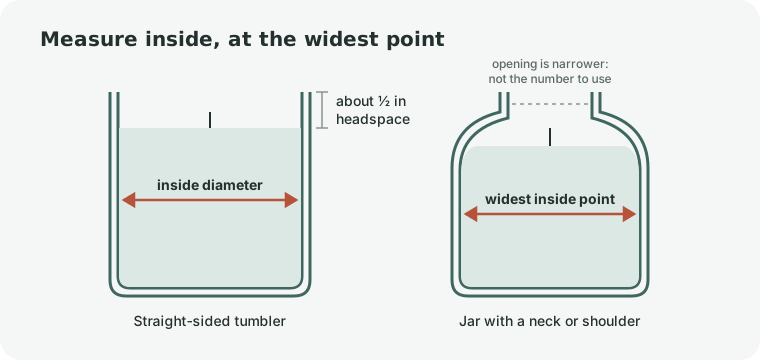
If your jar isn’t in the table, or comes from another supplier, the most reliable number takes two minutes to get. Set the empty jar on a kitchen scale, tare it, and fill it with water to where you want the wax to stop, which is usually about half an inch below the rim. Multiply the weight of the water by 0.86 and you have the weight of candle the jar holds, whatever its shape. The candle wax calculator does this for you and splits the result into wax and fragrance oil, and the pour day planner does it for a mix of jars in one batch.
Fill line and width are the two numbers that matter: one for the wax, one for the wick.
Width decides the wick
The wick column shows how much a jar’s width, rather than its volume, drives the rest of the recipe. The 16 oz mason jar holds more than twice the wax of the medium straight-sided jar, yet at 2.74 inches across it starts on a smaller wick than the 2.95 inch, 8 oz tin. Tall, narrow jars burn for longer on the same wick, while wide, shallow tins need a larger one to melt to the edge in a few hours.
Width also has a ceiling. CandleScience says that in its testing a jar over 3½ inches across is very difficult to wick with one wick, especially with soy and a high fragrance load, and it recommends 3 inches or less for easy wicking and less soot. All twelve containers here are under 3¼ inches, which is part of why they are popular. One caution on the diameters: they are measured across the top inside, so on a jar with a narrower neck than body, measure the widest point inside before you choose a wick. Our wick size chart explains how.
Glass, tin or ceramic
The container also changes how forgiving the candle looks. CandleScience points out that soy frosting shows clearly through clear glass, so opaque containers such as tins and ceramics are the easiest for soy, and they also hide wet spots where wax pulls away from the side. Clear glass suits bright paraffin colors and shows off a clean pour, but it also shows every flaw, as our guide to wet spots and frosting explains. Whatever you choose, use containers sold for candles: CandleScience notes that many jars aren’t made to handle a candle’s heat.
From wax weight to label
When you sell, the net weight on the label is what is actually in the jar, not the size in the jar’s name. A candle poured into the 8 oz tin above weighs about 5 ounces, wax and oil together, and that is the figure your label has to carry. The label net weight calculator works out the line in ounces and grams, and the shipping weight calculator adds the container for postage.
Common questions
How much wax does an 8 oz jar hold?
Less than 8 oz in most cases. In CandleScience’s listings, its 8 oz mason jar takes 7.9 oz of wax to the fill line and its 8 oz tin only 5 oz. The “8 oz” is closer to how much liquid the jar holds, and wax is lighter than water.
How much wax for a 16 oz candle?
CandleScience lists 12.3 oz of wax to the fill line for its 16 oz mason jar, which holds 16.4 fl oz to the brim. For your own jar, weigh the water it holds to your fill line and multiply by 0.86, or use our candle wax calculator.
Is the wax weight the same as the net weight on the label?
For a finished candle, the net weight is everything in the jar: wax plus fragrance oil and dye. Weigh a finished candle without its jar and lid, or use our label net weight calculator.
Why do tins hold so much less wax than their size?
Tins are filled further below the rim. In these listings, the fill line on the tins uses about two thirds of the brim volume, while most glass jars use 80% or more.
Honest limits
The table repeats one supplier’s published figures for its own containers; jars with similar names from other shops can differ in volume, wall thickness and fill line. CandleScience doesn’t say which wax its fill weights were measured with, so treat them as close estimates and weigh water in your own jar before a large order. The wick is a starting point for a burn test, never a final answer.
Sources
CandleScience product pages for each container in the table (linked from its name), for wax weight to fill line, volume to overflow, height and top inside diameter