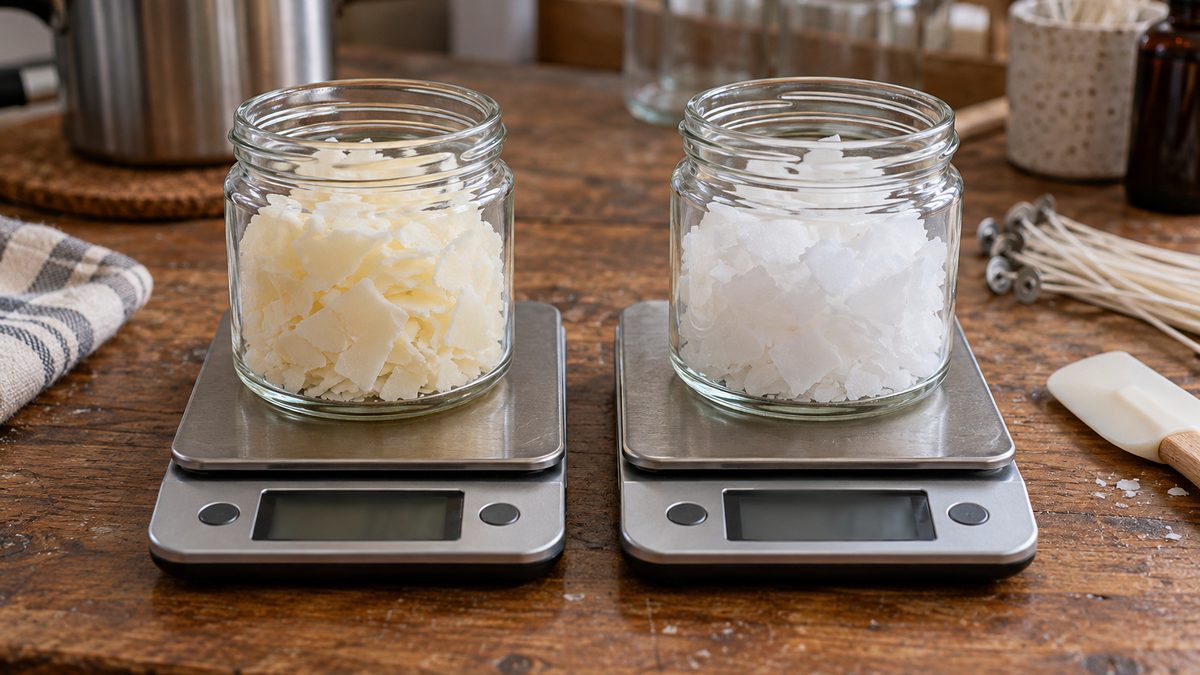
You order two kinds of jar, both sold as 8 oz. You pour the same recipe into each, and one comes out short while the other overflows the line you wanted. Neither jar is wrong. The “8 oz” just meant different things.
This guide compares the usual meanings of a jar’s size, shows with real numbers how much they can differ, and ends with the one measurement that makes them all agree. If you only want the measurement, skip to the water test.
What the size on the jar can mean
There are at least four different things a jar’s size can refer to. Suppliers and manufacturers don’t all use the same one.
| What “8 oz” can mean | What it measures | What it means for your wax |
|---|---|---|
| Overflow capacity | Fluid ounces of water, filled to the very top | The most it could hold. You won’t pour candles that full |
| Fill-line wax weight | Ounces by weight of wax, filled to a sensible line below the rim | The number you actually want, if the supplier lists it |
| Food industry size | What the jar holds of honey, jam or another food | Can be far from both of the above |
| Net weight of a finished candle | Ounces of candle (wax plus oil) on someone’s label | Fine for that candle, not for your recipe |
CandleScience spells this out on its container info page. Each of its jars lists “Wax Weight (to Fill Line)” and “Volume (to Overflow)” separately. The page also warns that many of its containers are made for the food industry, so the size on the box may not match either one. Its example is a container named for the weight of honey it holds.
A real example: the “12 oz” jar that takes 8.9 oz of wax
CandleScience’s 12 oz Status Jar is a good example because all its numbers are published:
- Name: 12 oz
- Volume to overflow: 11.80 fl oz (listed as 335.27 mL)
- Wax weight to fill line: 8.90 oz (252.31 g)
- Inside diameter at the top: 2.94 in
If you work out a fill from the overflow volume the usual way, taking the water volume and multiplying by the common 0.86 planning factor, 335 mL gives about 10.2 oz of wax to the brim. CandleScience recommends 8.9 oz instead, and says it suggests the lower fill “to make wicking a bit easier”.
So one jar has three honest numbers: 12, about 10.2 and 8.9. A recipe written for “a 12 oz jar” could mean any of them.
The glass itself: a quarter inch changes a lot
Two jars can look the same from outside and still hold different amounts, because what matters is the inside. Thick walls, a thick base or a curved bottom all take up space where wax would go.
Here is what the candle wax calculator gives for straight-sided jars with 3 inches of wax in them, using its cylinder mode and the 0.86 factor:
- 2.75 in inside diameter: about 8.86 oz of wax
- 3.00 in inside diameter: about 10.54 oz of wax
- 3.25 in inside diameter: about 12.37 oz of wax
A quarter inch more across the inside adds roughly 1.7 to 1.8 oz of wax at the same depth. Volume grows with the square of the diameter, so small differences in glass thickness or how you measure add up quickly.
This is also why the wick test planner asks for the inside diameter: it decides the wick as well as the wax.
The fill line: the same jar, three different candles
Even with one jar, where you stop pouring changes the amount. Take a tumbler that holds 8 fl oz to the brim. With the 0.86 factor:
- poured to the brim: about 7.18 oz of candle
- poured to 90%: about 6.46 oz
- poured to 80%: about 5.74 oz
Many makers leave room at the top for the wick, the lid and a cleaner look. Pick a fill line once, mark it, and use the same one every time, or your labels and your costs will drift.
Wax plus oil, not just wax
Once you know how much candle a jar holds, remember that the candle is wax and fragrance together. At 8% fragrance (as a percentage of the wax), a 7 oz fill is 6.48 oz of wax and 0.52 oz of oil, not 7 oz of wax. Our guide to finished fill weight vs wax-only weight works through this on a full pour day.
The only measurement that settles it
Every meaning of “8 oz” above becomes the same number once you do this once for each jar model:
- Put the empty jar on a scale and tare it.
- Fill it with water to the line where you want the finished candle to stop.
- Read the water weight in grams.
- Enter it in the candle wax calculator (water method). It multiplies by 0.86 and splits the result into wax and oil at your fragrance load.
Water follows every curve and the thick base, so the water measurement should already include the headspace you want.
Write the result on the jar’s spec card, and use that fill weight for every recipe in that jar.
0.86 is a planning factor, not a law. Waxes differ a little. Pour one real candle to your line, weigh it once it has set, and adjust the factor for that wax if it comes out a little high or low.
Why it matters for your label
If you sell in the US, a candle label states its net quantity, and the federal rules for that (16 CFR part 500) are about what is actually inside, not the jar’s name. A “12 oz Status Jar” poured to its 8.9 oz fill line is not a 12 oz candle. The label net weight calculator turns your real fill into a correct net weight line in ounces and grams. It rounds down so the label never claims more than is in the jar.
Honest limits
The jar figures are CandleScience’s published specs, and the other numbers come from our calculators using the common 0.86 factor. Jars of the same model can vary slightly between production runs, so weigh a sample from each new case.
Sources
- CandleScience: container info, for wax weight to fill line vs volume to overflow, and food-industry size labels
- CandleScience: 12 oz Status Jar, for the published fill, overflow and diameter figures and the recommended 8.9 oz fill
- eCFR: 16 CFR part 500, for US net quantity labeling rules


